Cuicocha
Cuicocha
Volcanic caldera perched at 3,246 m, two mysterious islets and turquoise waters: Cuicocha is one of Équateur's most stunning highland lakes.
Located in the Cotacachi canton in Imbabura Province, north of Quito, Cuicocha is the lagoon of an ancient stratovolcano caldera in the foothills of the western Andean range. Like Quilotoa, it ranks among Équateur's most beautiful high-altitude lakes. Its reputation rests on its fauna and flora, rich in diversity; not to mention its majestic, pastoral landscapes. It has become one of Équateur's most visited tourist destinations. It's an excellent choice for a relaxing weekend getaway.
History
The Cuicocha lagoon caldera formed following a phreatomagmatic eruption approximately 3,100 years ago. This eruption triggered a pyroclastic flow of 5 km³ and blanketed the surrounding region in volcanic ash. The name Cuicocha comes from the Quichua word Kuykucha, which literally means "Lago del Cuy" or "guinea pig lake." The lagoon bears this name because of the shape of one of its islands, which locals thought resembled a guinea pig.
Today
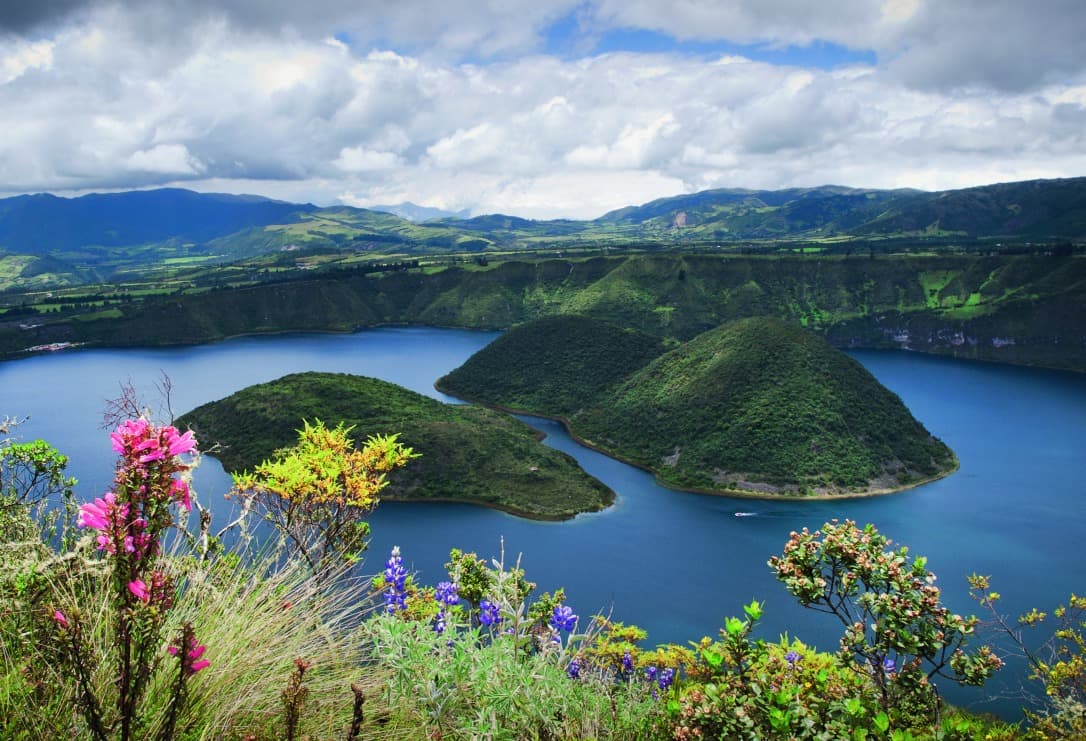
The Cuicocha lagoon dominates the floor of a caldera 3 km in diameter, 8 km in perimeter, and 200 m deep. It features crystal-clear waters in a deep blue hue that sometimes turns emerald, depending on the depth.
Emerging in the middle of the lagoon are two small islands known as Yerovi, the smaller of the two, and Teodoro Wolf, the larger. The two islets stand majestically amid its waters. They are separated in the middle by a channel locally known as the "canal of dreams." Off-limits to tourists, these two islands once served as an Incan prison. Today, they host two structures for monitoring the volcanoes.
For residents living in the surrounding area, particularly in the Otavalo valley, the lagoon plays an important role. Rich in proteins, the agricultural products from this region are recognized for their quality.
Reaching an altitude of over 3,246 m, the caldera offers a mountainous landscape. It is therefore surrounded by very high mountain ranges, with the Imbabura volcano to the left and Cayambe to the right.
Every year in June, during the celebration of the Sun Festival or Inti Raymi, the lake becomes a sacred place. On the second day of this ceremony, the indigenous shaman visits this location and performs a purification ritual by bathing. This ritual is a testament to gratitude toward Mother Earth for the harvest.
Discovering Cuicocha Lagoon
Given its exceptional landscapes and rich biodiversity, this volcanic lake offers various outdoor activities. During your visit, you'll have the opportunity to hike, enjoy horseback riding or boat excursions on its waters, and participate in kayaking competitions.
While visiting, travelers can enjoy a hike along an 8 km trail called Maximo Gorki Campuzano. The first kilometers feature steep hikes through grasslands, followed by a gentle walk around the lagoon, and finally a visit to the village of Quiroga. To make the most of your hike, it's advisable to walk around the lagoon clockwise.
Cuicocha lagoon is part of the treasures of the Cotacachi-Cayapas Nature Reserve, one of the world's richest ecosystems. Cuicocha's fauna is notably characterized by the silvery grebe, which feeds on small creatures living in the lake such as frogs, crayfish, and small water snakes. You may also encounter guinea pigs, Soche animals, wild rabbits, Andean foxes, and birds such as pigeons, doves, and sparrows. As for flora, it is heavily dominated by vegetation that develops on volcanic lava, such as bromeliads, calahuala, rosewood, cattails, and sigses. The region is home to over 400 species.
Located 14 km northwest of the city of Otavalo, Cuicocha lagoon is accessible by bus. To reach Quiroga, you can take a bus from Otavalo station heading toward Cotacachi. Once you arrive in Quiroga, you can take a taxi that will take you directly to Cuicocha lagoon.
Want to discover this destination?
Our local advisors design your tailor-made trip.